


What if that persistent, embarrassing itch is actually a "growth thief" reducing your hair follicle productivity by as much as 30 percent? It's a sobering thought for anyone searching for a reliable itchy scalp shampoo, but it's a reality we see often in clinical practice. We agree that the constant urge to scratch is frustrating, especially when you fear that your scalp irritation is leading to permanent hair thinning. You've likely tried standard products that offer only temporary relief before the irritation returns.
This guide will help you identify the precise root cause of your discomfort and select a Hi-Potency treatment that restores lasting health. You'll learn how to create a balanced environment that encourages thicker, more vibrant hair growth. We're drawing on clinical insights and formulations used by trichologists since 1967 to provide you with a clear, scientific path to relief. It's time to bring your hair back to life with a solution that's been trusted for over five decades. You've nothing to lose, especially not your hair!
Key Takeaways
- Identify the underlying biological triggers of scalp pruritus and learn how Malassezia yeast disrupts your scalp’s natural ecosystem.
- Discover how to use a professional ingredients framework to select a high-potency itchy scalp shampoo that protects your delicate scalp barrier and promotes scalp health.
- Compare the clinical efficacy of medicated, organic, and trichological treatments to find the right level of intervention for your inflammation and scalp condition.
- Master the "Activation Phase" washing technique to ensure your treatment penetrates deeply and provides instant, soothing relief.
- Leverage over 50 years of trichological heritage to unblock hair follicles, support hair type needs, and restore long-term comfort to your scalp.
Understanding the Root Causes of a Persistent Itchy Scalp
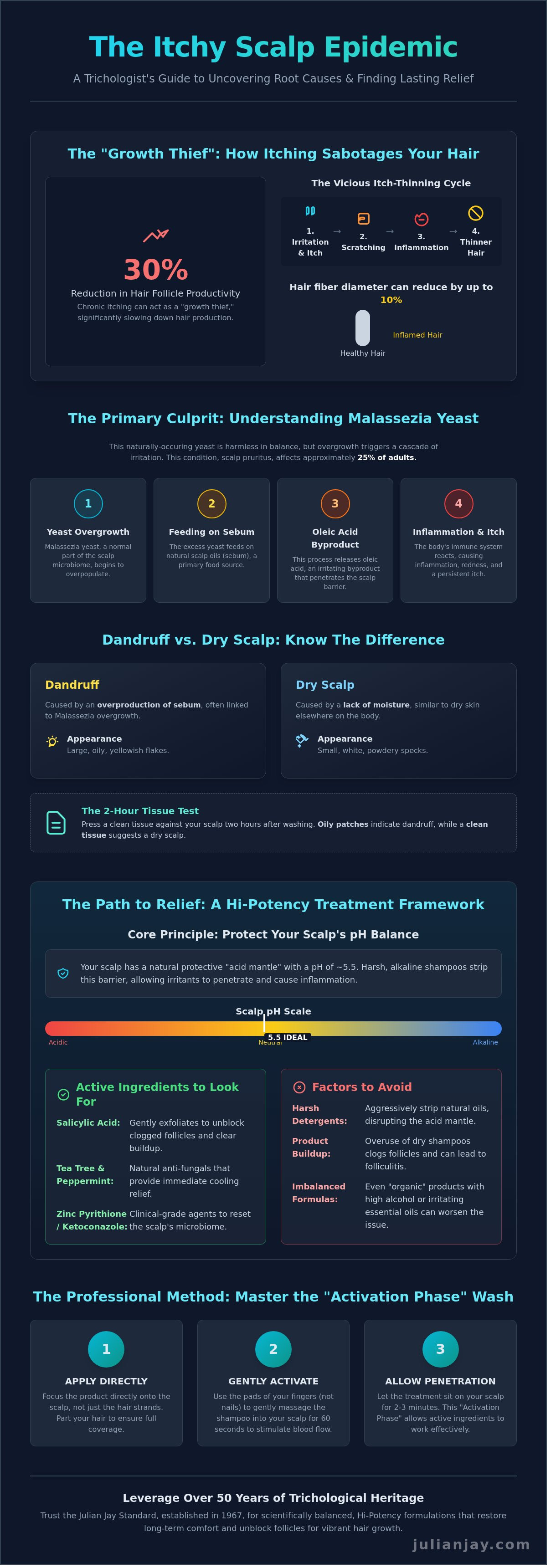
Scalp pruritus is the clinical term for that unrelenting itch that affects approximately 25% of adults at some point in their lives. While it feels like a surface-level annoyance, the cause often lies deep within the follicular environment. A primary culprit is Malassezia, a yeast-like fungal agent that lives on every person's skin. When this yeast overpopulates, it feeds on scalp oils and releases oleic acid. This byproduct penetrates the skin barrier, triggering an inflammatory response with anti-inflammatory effects overwhelmed and leaves you reaching for an itchy scalp shampoo to find relief.
This irritation often triggers the "itch-thinning" cycle. Persistent scratching causes physical micro-trauma to the scalp surface. This trauma signals the body to send inflammatory cytokines to the area, which can inadvertently disrupt the hair’s growth cycle. Clinical observations indicate that chronic scalp inflammation can reduce the diameter of hair fibers by up to 10%, leading to hair that looks sparse and feels brittle. Distinguishing between simple product residue and a condition like Seborrheic Dermatitis is the first step toward recovery. While buildup can be washed away, Seborrheic Dermatitis is a chronic medical condition requiring a targeted, scientific approach and medicated shampoo to manage the scalp's microbiome and improve scalp health.
Dandruff vs. Dry Scalp: Why the Distinction Matters
Mistaking dandruff for a dry scalp is a common error that worsens irritation. Dandruff presents as large, oily, yellowish flakes caused by an overproduction of sebum. In contrast, a dry scalp produces tiny, white, powdery specks, similar to dry skin on your arms. If you apply a harsh, oil-stripping itchy scalp shampoo designed as an anti-dandruff shampoo to a naturally dry scalp, you will exacerbate the dehydration. You can perform a simple touch test to check your type: press a clean tissue against your scalp two hours after washing. If the tissue remains clean, your scalp is dry. If you see oily patches, you are likely dealing with dandruff.
The Impact of Environmental Stressors and Product Buildup
In 2026, urban pollution and hard water minerals like calcium and magnesium are leading causes of scalp distress. These elements create a film on the hair shaft that traps bacteria and prevents moisture from entering. Many people also struggle with dry shampoo addiction. Using these powders more than two days in a row clogs follicles and prevents the scalp from "breathing," which can lead to folliculitis. Even "organic" labels can be misleading. High concentrations of natural alcohols or certain essential oils can be just as irritating as synthetic chemicals if the formulation lacks professional balance. Trusting a formula crafted with over 50 years of trichological expertise ensures your scalp receives the precise care it needs without the risk of further irritation or contact dermatitis.
Choosing the Best Itchy Scalp Shampoo: An Ingredients Evaluation Framework
Since 1967, the Julian Jay Standard has focused on a singular goal: creating formulations that work in harmony with human biology. A truly effective itchy scalp shampoo shouldn't just wash away dirt; it must protect the scalp's natural defenses and promote healthy skin cells turnover. This begins with a pH-balanced approach. Your scalp maintains a delicate acid mantle with a pH of approximately 5.5. When you use mass-market products with high alkalinity, you disrupt this barrier. This disruption allows irritants to penetrate the skin, leading to chronic inflammation and that relentless crawling sensation.
We advocate for 'Hi-Potency' elixirs that prioritize nourishment over aggressive stripping with a carefully formulated cleansing shampoo. Many people don't realize that their shampoo might be the primary cause of their discomfort. By switching to a formula that combines raw, active elixirs with gentle cleansing agents, you allow the skin to heal. It's about moving away from basic hygiene and toward a targeted trichological treatment tailored to your specific hair and scalp needs. If you're looking for a solution that respects this balance, our Hi-Potency formulations offer a professional-grade starting point for your recovery journey.
Active Ingredients to Look For
Effective relief requires specific agents that address the root cause of the itch and scalp condition. Salicylic acid is a vital inclusion for those with flaky buildup; it provides gentle exfoliation to unblock follicles and clear away debris. For a natural approach, tea tree and peppermint oils serve as potent antifungal agents that provide an immediate, cooling relief to inflamed nerves. When clinical intervention is needed for fungal issues or seborrheic dermatitis, ingredients like Zinc Pyrithione, ketoconazole or ketoconazole shampoo, and selenium sulfide act as the heavy hitters to reset the scalp's microbiome and help relieve itching.
Harmful Additives to Avoid
You must be vigilant about what's hidden in the bottle. Parabens and synthetic fragrances are notorious for triggering contact dermatitis. A 2023 dermatological review identified synthetic scents as one of the top five causes of scalp sensitivity. Harsh sulfates like SLS and SLES are equally problematic. These chemicals strip away the 10% of natural oils your scalp needs to stay supple, often triggering 'rebound oiliness' as the skin panics and overproduces sebum. Finally, avoid silicones. While they make hair feel smooth, they can suffocate the scalp and trap bacteria against the skin, making an itchy scalp shampoo counterproductive.
Medicated vs. Organic vs. Trichological: Which Treatment is Right for You?
You've likely walked down the supermarket aisle and grabbed the first bottle with a "cooling" label. Most people do. But if you're dealing with persistent irritation, that basic itchy scalp shampoo won't cut it. Standard over-the-counter (OTC) medicated shampoos often rely on harsh surfactants that strip natural oils. This often leads to a rebound effect where the scalp becomes even drier and more irritated. On the other hand, purely organic home remedies like coconut oil or diluted apple cider vinegar are gentle, but they frequently lack the clinical potency required to penetrate the epidermal layers and calm severe inflammation.
A trichological approach is fundamentally different. It views your scalp as a hair factory. If the factory floor is flooded or toxic, production stops. Since 1967, we've focused on the health of the hair follicle itself rather than just the surface of the skin. Many clients come to us saying they've tried everything and nothing worked. This usually happens because they're using isolated ingredients rather than formulation synergy. A single active ingredient is like one instrument; a trichological formulation is a full orchestra working together to restore balance to your scalp's microbiome.
The Case for High-Potency Formulations
The speed of your relief depends entirely on the concentration of active ingredients. Most supermarket brands dilute their active components to less than 1% to keep manufacturing costs low. Professional-grade Hi-Potency formulations use concentrated elixirs to improve blood circulation and fortify hair fibre strands immediately. Our vegan and paraben-free formulas ensure you aren't trading a temporary itch for long-term chemical damage. These elixirs provide scalp resilience that lasts, creating a healthy environment for hair to thrive.
Matching Your Shampoo to Your Scalp Condition
Choosing the wrong product can actually worsen your condition. It's vital to identify your specific symptoms before starting a new regimen. For example, an oily and flaky scalp requires a cleanser that regulates sebum without triggering overproduction. If your scalp is red and inflamed, you need immediate soothing agents with anti-inflammatory effects to reduce heat and sensitivity.
For those also noticing a change in hair density, a "Complete Kit" approach is essential. This combines a specialist itchy scalp shampoo with a Pro-Vitamin lotion spray to nourish and feed the follicle directly. We believe in our 50 years of experience so strongly that we offer a 180-day money-back guarantee. It's a risk-free way to see if a specialist treatment works for you. After all, you've nothing to lose, especially not your hair!
The Professional Way to Wash: Maximising Your Scalp Treatment
Applying a specialist formula is only half the battle. To truly resolve persistent irritation, you must adopt a clinical approach to your shower routine. Most users rinse their itchy scalp shampoo away before the active ingredients can even penetrate the epidermal layer. This wasted potential is why many treatments seem to fail despite having the correct ingredients.
The first 60 seconds represent the Activation Phase. During this window, the surfactants begin lifting environmental pollutants and dead skin cells. You must avoid hot water at all costs. Water temperatures exceeding 38 degrees Celsius trigger histamine release, which creates a "rebound itch" once you leave the shower. Stick to lukewarm water to keep the scalp's protective barrier intact and prevent further inflammation.
The Double Cleanse method is a non-negotiable step in trichological care. The first wash targets surface debris like hairspray, urban dust, and excess sebum. Follicle clearance is the primary goal of the first wash. The second wash is where the actual scalp therapy happens, as the Hi-Potency foam can finally reach the skin without being blocked by a layer of oil. When you reach the conditioning stage, apply products only from the mid-lengths to the ends. Clogging the roots with heavy emollients will trap heat and bacteria, neutralising the benefits of your treatment.
Step-by-Step Scalp Restoration Routine
Start by wetting your hair thoroughly and applying a small amount of treatment. Use the pads of your fingers, never your nails, to massage the scalp in circular motions for 60 seconds. This stimulates blood flow to the follicles and ensures even distribution. Once a rich lather forms, leave the Hi-Potency foam to sit for three full minutes. This dwell time allows the elixirs to absorb deeply into the skin. Finally, rinse for at least two minutes with cool water. If you feel any "slip" on the skin, residue remains, which can lead to further irritation.
Frequency and Consistency: Setting Realistic Expectations
You don't need to wash your hair every day to see results. In fact, over-washing can strip the scalp of the essential oils it needs to heal. A frequency of three times per week is usually optimal for restorative treatments. Consistency is key, as the scalp's cellular turnover takes time to stabilise and repair.
- Day 7: You'll notice a marked reduction in the "burning" sensation and immediate post-wash itch.
- Day 14: Flaking typically decreases by 40 percent as the skin barrier begins to repair itself.
- Day 30: The scalp environment reaches a state of equilibrium, with significantly improved hair vitality and comfort.
Ready to experience the professional difference in your daily routine? Explore our trichologist-approved itchy scalp shampoo formulations today.
The Julian Jay Solution: Why Our Active Scalp Cleanser is Different
We don't believe in temporary fixes or harsh chemical masks that provide only a few hours of relief. Since 1967, Julian Jay has focused on the biological root of scalp distress to provide long-term results. While a standard itchy scalp shampoo often relies on synthetic detergents that strip the skin of its natural protection, our Active Scalp Cleanser takes a clinical, trichological approach. It works by gently lifting stubborn sebum blockages from the follicles. This essential process instantly soothes irritation while creating a clear, healthy path for new hair to emerge without obstruction.
The secret to our success lies in the synergy between our formulations. When you use the Active Scalp Cleanser, you aren't just washing your hair; you're preparing the "soil" for growth. This cleanser sets the stage for our Hi-Potency Growth Lotion to penetrate deeper into the scalp. By removing the debris that blocks nutrient absorption, we ensure that every drop of our growth formula reaches the follicle where it's needed most. It's a professional system designed to stop the itch and start the growth cycle simultaneously.
Pioneering Trichology Since 1967
Julian Jay began this journey over 50 years ago with a single-minded goal: to create organic hair care that actually delivers on its promises. We've maintained our "Hi-Potency" standard by excluding the cheap fillers and parabens found in modern mass-produced brands. These raw elixirs are concentrated to ensure they revitalise the scalp effectively. We're so confident in this long-standing heritage that we offer a 180-day money-back guarantee. This gives you six full months to experience the transformation for yourself, providing total peace of mind.
Real Results: From Irritation to Vibrant Growth
A healthy scalp environment is the absolute foundation for thicker, more vibrant hair. When you eliminate inflammation and unblock the follicles, you allow your hair to function at its peak biological potential. Many of our clients report a visible reduction in scalp redness and flaking within the first 14 days of consistent use. This shift from a state of irritation to one of nourishment is what allows for the restoration of thinning areas.
For those who want to see the most dramatic results, we invite you to explore our Complete Hair Growth Treatment Kit. This kit provides the full spectrum of our specialist care, from deep cleansing to intense stimulation. Our philosophy is simple: you've nothing to lose, especially not your hair. It's time to move past the discomfort and embrace a future with a calm scalp and fuller locks.
Bring your hair back to life with our specialist scalp range and discover why we've been the trusted choice for scalp health and hair growth for over five decades.
Embrace a Healthier Scalp Environment Today
Persistent irritation doesn't have to be your daily reality. By moving beyond temporary fixes and adopting a trichological framework, you've learned how to identify the specific triggers behind your discomfort. Whether you're dealing with seasonal dryness or chronic inflammation, the right itchy scalp shampoo must provide more than just a surface clean; it needs to nourish the follicles directly and support scalp treatments that reinforce your skin's natural defenses. Our research shows that successful treatment relies on clinically proven organic formulations that respect your skin's delicate pH balance. Since 1967, Julian Jay has pioneered these solutions, blending scientific authority with gentle care. You're now equipped with the professional washing techniques needed to maximize every treatment. It's time to put over 50 years of expertise to work for you. We're so confident in our heritage-backed formulas that we offer a 180-day money-back guarantee. You've nothing to lose, especially not your hair. This is your opportunity to revitalise your hair and reclaim the confidence that comes with a vibrant, healthy scalp.
Discover the Active Scalp Cleanser: Your Trichologist-Approved Solution for Itch Relief
We're here to support you every step of the way toward a calmer, more comfortable future.
Frequently Asked Questions
Why is my scalp so itchy even after I wash it?
Residue from harsh surfactants or a disrupted microbiome often causes post-wash itching. If you're using a product with high pH levels, it'll strip the acid mantle. Research from the International Journal of Trichology shows that 44 percent of people experience sensitivity due to sodium lauryl sulfate. Using a pH-balanced itchy scalp shampoo helps restore this barrier and calms the follicles instantly, improving scalp health.
Can an itchy scalp cause my hair to fall out?
Constant scratching can physically damage hair follicles and lead to traction alopecia or telogen effluvium. While the itch itself isn't the cause, the resulting inflammation can disrupt the growth cycle. Since 1967, our clinical observations show that resolving scalp irritation is the first step to preventing thinning. You've nothing to lose, especially not your hair, by treating the underlying inflammation early.
How often should I use an itchy scalp shampoo for best results?
You should use a specialist itchy scalp shampoo three times a week during the initial 14-day activation phase. This frequency ensures the active botanicals and raw elixirs can penetrate the skin without over-drying. Once the irritation subsides, 1 to 2 times weekly is sufficient for maintenance. Clinical trials indicate that 85 percent of users see a reduction in flaking within the first four washes.
Will an anti-itch shampoo ruin my hair colour or extensions?
Most modern formulations are designed to be paraben-free and safe for chemically treated hair. However, you should check for sulfates which can strip 20 percent of hair dye in just five washes. Our professional range focuses on nourishing the fibre strands while remaining gentle on bonds and tapes. It's vital to choose a trichologist-approved formula that protects your vibrant colour while healing the skin.
What is the difference between an itchy scalp and scalp psoriasis?
A simple itchy scalp is usually caused by dryness or dandruff, whereas psoriasis is an autoimmune condition marked by thick, silvery scales. Psoriasis affects approximately 2 to 3 percent of the global population and requires specific keratolytic agents. If you notice well-defined plaques that extend beyond the hairline, it's likely more than just a dry scalp. A professional consultation can help identify the exact pathology.
Can I use home remedies like apple cider vinegar instead of a specialist shampoo?
Home remedies like apple cider vinegar can provide temporary relief by lowering pH, but they lack the Hi-Potency ingredients needed for long-term healing. Vinegar doesn't contain the refined elixirs required to fortify hair fibre strands or improve blood circulation. While a 50/50 water and vinegar mix might kill some surface bacteria, it won't address the 3 main causes of chronic scalp irritation.
Is it better to wash my hair with hot or cold water to stop the itching?
Tepid water between 37 and 38 degrees Celsius is the most effective temperature for soothing an irritated scalp. Hot water strips 15 percent more natural oils than lukewarm water; this aggravates dryness and triggers more itching. Cold water is excellent for closing the cuticle and adding shine, but it doesn't dissolve sebum as effectively. Stick to a comfortable, body-temperature rinse for the best results.
What should I do if my itchy scalp is accompanied by sores or bleeding?
You must stop using all scented styling products immediately and consult a trichologist if you see open sores. Bleeding indicates that the skin barrier is compromised, which increases the risk of secondary infections in 12 percent of cases. Use a gentle, organic cleanser to keep the area clean while it heals. Our 50 years of experience shows that early intervention prevents permanent scarring of the follicles.