


What if the "natural" remedy you're rubbing into your follicles is actually making your inflammation worse? We understand the quiet anxiety of wearing a dark blazer and constantly checking your shoulders for white flakes, or the fear that persistent itching is a precursor to hair thinning. You've likely heard that using tea tree for dandruff is a miracle cure, but without the right professional formulation, you could be risking more than just an itchy scalp. It's a common struggle for the 50 percent of adults worldwide who experience malassezia related scalp issues at some point in their lives.
At Julian Jay, we've spent over 50 years crafting solutions that balance clinical efficacy with gentle, expert care. You deserve to understand the science-backed reality of how these botanical extracts interact with your skin. This article will show you how to achieve a flake-free, healthy scalp without compromising your hair's vibrancy. We're going to debunk 5 common myths using trichological facts and provide a clear path to reduced inflammation. You'll learn exactly how to use these ingredients safely to ensure you have nothing to lose, especially not your hair.
Key Takeaways
- Learn why mistaking dandruff for simple dry skin could be worsening your condition and how to identify the biological reality of your scalp flakes.
- Discover the clinical power of using tea tree oil for dandruff and why the specific active compound Terpinen-4-ol is the hero of any effective formulation.
- Understand the hidden risks of DIY essential oil mixtures and how to avoid contact dermatitis by choosing professionally balanced, hi-potency cleansers.
- Master the trichologist-approved method for transitioning your routine to achieve a flake-free finish while maintaining optimal scalp moisture.
- Uncover the vital link between chronic scalp inflammation and hair thinning to ensure your follicles remain vibrant and productive for years to come.
Understanding Dandruff: Is It Just Dry Skin?
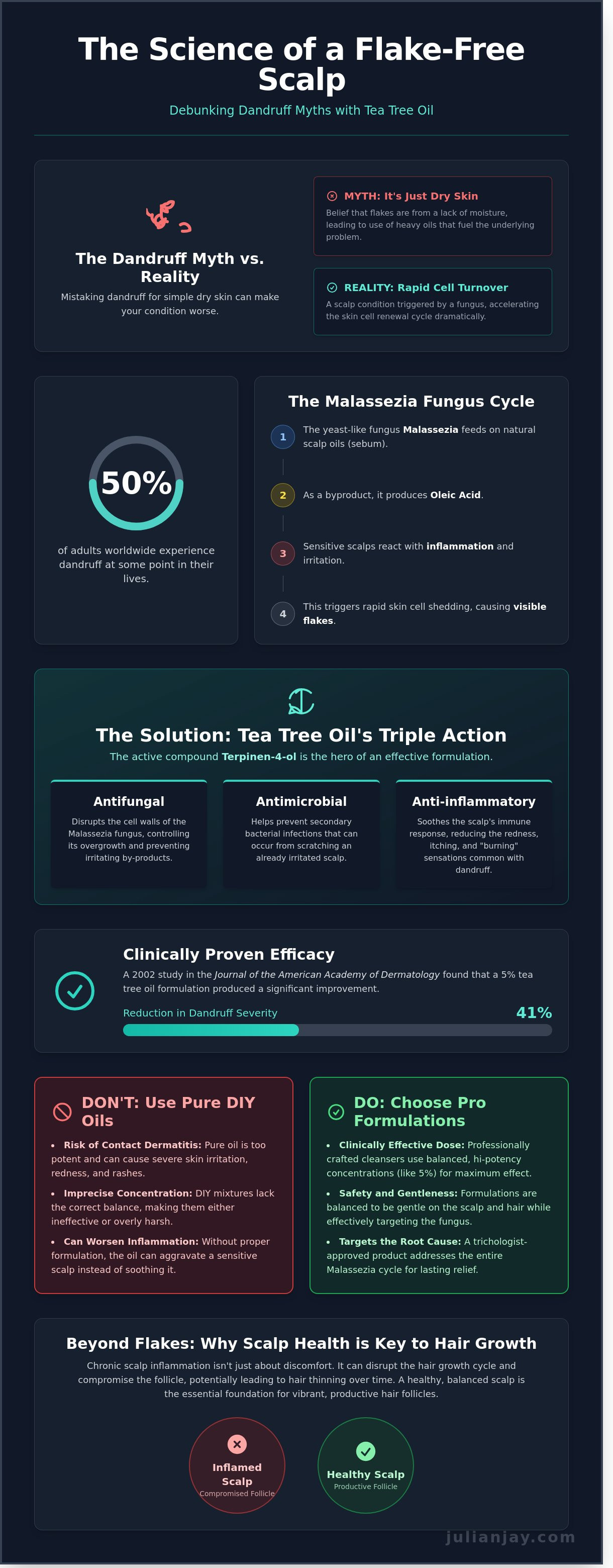
Seeing white flakes on your shoulders often feels like a personal defeat. It's a condition that affects approximately 50% of the global adult population at some point in their lives. Most people assume these flakes indicate a lack of moisture, so they reach for heavy oils or thick conditioners. This is the "Dry Skin Myth." In reality, dandruff is a scalp condition involving rapid skin cell turnover rather than simple dehydration. A healthy scalp replaces cells roughly every 28 days. A dandruff-prone scalp speeds this process up to every 7 to 10 days. Adding moisture to this environment usually makes the problem worse by providing more fuel for the underlying cause.
The frustration of chronic flaking is deeply personal. It impacts your confidence in social settings and professional meetings, leading to a cycle of stress that can further aggravate the scalp. Our clinical experience since 1967 shows that addressing the biological trigger is the only way to find lasting relief. This is where tea tree oil for dandruff becomes a vital part of a professional trichological regimen. Derived from the Melaleuca alternifolia plant, this essential oil has been used for decades to restore balance to the scalp's microbiome. It doesn't just mask the flakes; it addresses the specific environment that creates them.
The Malassezia Factor
The primary driver of most dandruff cases is a yeast-like fungus called Malassezia. This microorganism lives on almost every adult scalp without issue. However, it survives by feeding on sebum, the natural oils produced by your follicles. As the fungus breaks down these oils, it creates oleic acid as a byproduct. Research indicates that 1 in 2 people are sensitive to this acid. This sensitivity triggers an inflammatory response, causing the scalp to shed skin cells prematurely. Standard shampooing often fails to control this growth because regular cleansers don't have the specific antiseptic properties needed to manage fungal populations effectively.
Dandruff vs. Scalp Psoriasis
Identifying your specific condition is vital before you start using tea tree oil for dandruff. Dandruff flakes are usually oily and appear white or yellow. Scalp psoriasis is different. It's an autoimmune issue that creates thick, silvery scales with sharply defined red edges. These patches often extend past the hairline or appear on other parts of the body like elbows. If your scalp feels excessively tight, bleeds, or shows no improvement after 14 days of targeted care, you should consult a specialist. A professional trichologist can provide the hi-potency formulations required for these more complex scalp disorders.
The Science of Tea Tree (Melaleuca) Oil
Long before modern trichology, the Bundjalung people of New South Wales, Australia, utilised the crushed leaves of the Melaleuca alternifolia tree to treat skin infections. This isn't just folklore; it's the foundation of botanical medicine. When you use tea tree oil for dandruff, you're applying a complex mixture of over 100 different compounds that work in harmony to restore scalp health. These essential oils offer a potent alternative to harsh synthetic chemicals that can often strip the hair of its natural vitality.
The most critical evidence for this treatment comes from a landmark 2002 study published in the Journal of the American Academy of Dermatology. Researchers tracked 126 participants over a four week period to measure the oil's impact. Results were definitive: those using a 5% tea tree oil concentration saw a 41% reduction in dandruff severity. This data validates tea tree oil for dandruff as a clinical solution, particularly for those who prefer a more natural approach to scalp care.
Antifungal and Antimicrobial Power
The primary cause of dandruff is an overgrowth of Malassezia yeast. Tea tree oil functions by disrupting the permeability of these fungal cell membranes. Once the cell wall is compromised, the fungus can't maintain its internal balance and effectively dies off. This process prevents the yeast from feeding on scalp oils and releasing irritating by-products. Terpinen-4-ol is the primary bioactive component of tea tree oil responsible for its potent ability to inhibit the growth of pathogenic fungi and bacteria. By maintaining this antimicrobial environment, the oil also helps prevent secondary bacterial infections that often occur when the scalp's protective barrier is broken by scratching.
Reducing Scalp Inflammation
Dandruff often brings a distressing "burning" sensation and visible redness. Tea tree oil acts as a natural anti-inflammatory agent that calms the skin's immune response and reduces swelling around the follicles. Its natural astringent properties help regulate sebum production, ensuring the scalp isn't an oily breeding ground for future flakes. When you reduce the urge to scratch, you prevent physical trauma to the hair fibre and the delicate scalp surface. If you're struggling with persistent irritation, a specialist scalp formulation can provide the professional-grade relief your hair needs to thrive again. This holistic approach ensures your scalp remains a healthy, balanced environment for vibrant hair growth.
Myth vs. Reality: Can You Just Use Pure Tea Tree Oil?
Many people assume that applying 100% pure essential oil is the fastest way to see results. This "more is better" philosophy is a dangerous misconception in the world of scalp care. Essential oils are incredibly potent chemicals. Using them at full strength often leads to irritant contact dermatitis, a painful skin reaction. A 2010 study published in the journal Dermatitis highlighted that tea tree oil can cause allergic reactions in 3.5% of users when it isn't handled with professional care.
The "DIY shaking" method also fails to deliver consistent results. You might think adding a few drops to your standard shampoo is enough, but oil and water-based formulas don't mix without help. Without professional emulsifiers, the oil remains separated. This means one wash might contain zero active ingredients, while the next delivers a concentrated dose that causes a chemical burn. For those with naturally oily scalps, applying pure oils can actually "lock in" flakes. This creates a thick, sticky layer of sebum and dead skin that clogs follicles and makes the condition harder to treat.
The Danger of Undiluted Essential Oils
The scalp is one of the most sensitive and vascular areas of your body. It absorbs substances much faster than the skin on your limbs. If you use undiluted tea tree oil for dandruff, you risk severe skin irritation. You should watch for warning signs like intense stinging, persistent redness, or the appearance of tiny blisters. Even "natural" products require a 24-hour patch test behind the ear. A trichologist will tell you that "natural" doesn't always mean "gentle" when the concentration is wrong.
Professional Formulations vs. DIY Mixes
Expertly crafted formulations provide a level of safety and efficacy that a home mix can't match. Professional products use specific emulsifiers to ensure every single drop of the cleanser contains the exact right dose of active ingredients. This consistency is vital for long-term scalp health. Additionally, professional cleansers are pH-balanced to sit at approximately 5.5, the scalp's natural environment. DIY additions often spike the pH, which forces the hair cuticle to swell and leads to frizz and breakage.
- Consistency: Every wash provides a measured, safe dose of active elixirs.
- Cuticle Protection: pH-balanced formulas keep hair strands smooth and strong.
- Deep Cleansing: Active cleansers lift away debris rather than just coating the scalp in oil.
Relying on a Hi-Potency, clinically proven formulation ensures you're treating the root cause of the issue without causing secondary damage. When you use a professionally developed tea tree oil for dandruff solution, you benefit from decades of scientific research rather than guesswork. It's the difference between a temporary fix and a sustainable, healthy scalp environment.
How to Safely Incorporate Tea Tree into Your Routine
Transitioning to a specialized routine involves more than just swapping bottles. Start by replacing your standard cleanser once every three washes, gradually increasing frequency as your scalp acclimates. This phased approach prevents a "rebound effect" where the scalp overproduces sebum in response to new active ingredients. We've spent over 50 years refining these transitions to ensure your hair remains vibrant throughout the healing process.
Finding your "sweet spot" depends on your unique physiology. For those with oily seborrheic dermatitis, using tea tree oil for dandruff three to four times weekly provides optimal control. If you have a sensitive or dry scalp, limit use to twice a week to maintain the essential lipid barrier. Avoid using hot water during this process. Water temperatures exceeding 38°C (100°F) can trigger inflammatory responses and strip the very moisture you're trying to protect, often negating the benefits of the treatment.
Identifying the Right Concentration
Clinical research, including studies published in the Journal of the American Academy of Dermatology, identifies a 5% concentration as the gold standard for efficacy. When reading labels, look for "Melaleuca alternifolia leaf oil" rather than generic "fragrance" or "parfum." Synthetic oils lack the terpinen-4-ol compound responsible for antimicrobial action. Utilising tea tree oil for dandruff in a Hi-Potency, clinically proven formulation ensures you aren't just washing with a scent, but applying a targeted solution.
Application Techniques for Maximum Relief
The "Double Wash" method ensures a truly clean canvas for your follicles. The first wash removes surface debris and styling products, while the second allows the active elixirs to penetrate the scalp. Use your fingertips to massage the scalp in circular motions, avoiding the use of fingernails which can create micro-tears in the skin. For the best results, allow the lather to remain in contact with your scalp for three to five minutes before rinsing thoroughly with lukewarm water.
Managing your expectations is vital for a hopeful journey toward a healthier scalp. While some users report immediate cooling relief, clinical data suggests that a 41% reduction in flaking typically requires four to six weeks of consistent application. Stick with the process; your patience will be rewarded with a thicker, fuller, and flake-free head of hair. Individual results will vary, but consistency is the bridge to a revitalised scalp.
Beyond Flakes: Why Scalp Health is the Key to Hair Growth
At Julian Jay, our philosophy since 1967 has remained steadfast: you cannot grow vibrant hair from a neglected scalp. While many people search for tea tree oil for dandruff as a quick fix, they often overlook the deeper biological impact of a flaking scalp. Chronic inflammation isn't just an itch. It's a signal that your scalp is under stress. This persistent irritation can lead to follicle miniaturization, a process where follicles shrink and produce progressively thinner strands. Eventually, these follicles may stop producing hair altogether.
The physical act of scratching also takes a toll on your appearance. Intense itching leads to mechanical hair breakage, snapping healthy strands before they reach their full potential. It's time to shift your mindset. Stop simply "treating a problem" and start "nourishing a future" for your hair. A healthy scalp is the essential foundation for the thick, full hair you deserve.
The Link Between Dandruff and Thinning Hair
Dandruff isn't just about the flakes you see on your shoulders; it's about what's happening beneath the surface. Clogged follicles, filled with a mix of excess sebum and dead skin cells, create a physical barrier that hinders new hair growth. When Malassezia fungal overgrowth occurs, it triggers an inflammatory response that can shorten the anagen growth phase of your hair cycle. Clinical observations suggest that clearing scalp congestion is often the vital first step in any successful hair regrowth plan. Without a clear path, new strands struggle to emerge.
The Julian Jay Solution
We don't believe in temporary fixes or surface-level treatments. Our Active Scalp Cleanser offers a professional, trichological alternative to basic supermarket solutions. While tea tree oil for dandruff has its place in natural remedies, our formulation draws on 50 years of experience to provide a Hi-Potency cleanse that revitalises the scalp environment. This isn't just a shampoo; it's a scientific approach to hair health.
- Expertise: Formulated by a pioneering trichologist with over five decades of clinical success since 1967.
- Action: Targets fungal overgrowth while improving blood circulation to the follicles to fortify hair fibre strands.
- Confidence: Backed by our 180-day money-back guarantee, because we believe in the power of our formulations.
The foundation for thicker, fuller hair starts with a clean, healthy scalp. Use our Active Scalp Cleanser to transform your hair care routine into a professional regrowth strategy. You've nothing to lose, especially not your hair!
Take Control of Your Scalp Health Today
Managing persistent flakes requires more than a quick fix. You've learned that dandruff is often a complex microbial imbalance rather than simple dryness. While using tea tree oil for dandruff provides potent antifungal benefits, applying pure essential oils directly to your skin can lead to severe skin irritation. True relief comes from professional, clinically inspired formulations that balance raw potency with scalp safety.
Julian Jay has provided expert hair solutions since 1967. We've spent over 50 years perfecting our trichological approach to ensure your follicles stay nourished and your scalp remains vibrant. You've nothing to lose, especially not your hair. Our heritage of expertise is built on proven results, which is why we proudly offer a 180-day money-back guarantee on our formulations. It's the most reliable way to transition from managing symptoms to achieving lasting scalp health.
Bring your scalp back to life with our Active Scalp Cleanser
It's time to stop worrying about your hair and start enjoying the confidence of a healthy, flake-free scalp. Your journey to thicker, more resilient hair starts with a foundation of professional care.
Frequently Asked Questions
Can I leave tea tree oil on my scalp overnight?
You shouldn't leave pure tea tree oil on your scalp overnight because its high concentration can cause contact dermatitis in 10% of users. As a trichologist-led brand since 1967, we recommend limiting exposure to 15 or 20 minutes when using it as a pre-wash treatment. Leaving it on for 8 hours risks sensitising the skin and weakening the hair follicles. Our goal is to nourish your scalp, not irritate it.
Does tea tree oil work for all types of dandruff?
Tea tree oil is most effective against Malassezia-related dandruff, which accounts for approximately 90% of common flake cases. It possesses antifungal properties that target this specific yeast effectively. However, if your scalp issues stem from psoriasis or eczema, using tea tree oil for dandruff may actually cause more irritation than relief. A professional diagnosis ensures you're treating the correct underlying condition to bring your hair back to life.
Can tea tree oil cause hair loss if used incorrectly?
Tea tree oil won't cause hair loss directly, but improper use that leads to chemical burns can damage the follicles. Clinical studies show that severe scalp inflammation can trigger telogen effluvium, leading to a 30% increase in shedding. Always dilute the oil to a concentration of 5% or less to maintain a healthy environment. This helps your hair grow thicker, fuller, and more vibrant without any risk.
Is it safe to use tea tree for dandruff on color-treated hair?
You can safely use tea tree for dandruff on color-treated hair if you choose a pH-balanced formulation. Pure essential oils act as solvents and can strip 15% of artificial pigment during a single wash. Our expert formulations are designed to revitalise the scalp without compromising your expensive salon color. This ensures your hair remains healthy while the flakes disappear, keeping your look vibrant and fresh.
How often should I use a tea tree shampoo for the best results?
You should use a tea tree shampoo 2 or 3 times a week to manage fungal growth effectively. Over-washing can strip the natural oils, causing the scalp to produce 20% more sebum to compensate for the dryness. Following this specific schedule helps nourish the scalp while keeping flakes at bay. It's a method we've refined over 50 years of clinical experience to ensure your hair stays healthy.
Can I use tea tree oil for my child’s dandruff?
You shouldn't use tea tree oil on children under the age of 12 without a professional consultation. Pediatric skin is 20% thinner than adult skin, making it far more susceptible to allergic reactions and irritation. If you decide to use it for an older child, ensure the concentration is below 1% to avoid distressing skin reactions. Safety is always the priority for young follicles to ensure healthy future growth.
What should I do if my scalp burns after using tea tree oil?
You must rinse your scalp immediately with cool water and a mild, fragrance-free cleanser if you feel a burning sensation. Apply a cold compress for 10 minutes to reduce inflammation and blood flow to the affected area. If the redness persists for more than 24 hours, contact a specialist to ensure you haven't suffered a chemical burn. Never apply undiluted oils directly to sensitive skin to avoid these issues.
Is tea tree oil more effective than Zinc Pyrithione?
Zinc Pyrithione remains the clinical gold standard, though a 2002 study published in the Journal of the American Academy of Dermatology found 5% tea tree oil reduced dandruff by 41%. While tea tree oil is a powerful natural alternative, Zinc Pyrithione often provides faster results for severe cases. We combine the best of science and nature to ensure your hair stays healthy, vibrant, and flake-free for the long term.