


Navigating the world of hair loss treatments can feel overwhelming. You're met with conflicting advice online, dramatic before-and-after photos, and worrying stories about side effects. It’s easy to feel stuck, questioning if a clinically recognised treatment like minoxidil is a genuine solution or just another source of anxiety. You are not alone in wondering if the results are worth the long-term commitment, or in fearing that the infamous 'dread shed' could make things worse before they get better.
This comprehensive guide is designed to cut through that noise with clinical clarity. Drawing on decades of trichological expertise, we will provide an unbiased, evidence-based look at how minoxidil works to revitalise hair follicles and encourage new growth. We will establish a realistic timeline for results, demystify potential side effects, and explore how it compares to other proven treatments. Our goal is to empower you with the professional understanding needed to confidently decide if this is the right path for your hair restoration journey.
What is Minoxidil and How Does It Work for Hair Loss?
For those struggling with thinning hair, minoxidil is one of the most recognised and clinically proven treatments available over-the-counter in the UK. Its journey from a cardiovascular drug to a leading hair loss solution is a fascinating story of accidental discovery. Originally developed as an oral medication to treat high blood pressure, doctors observed a peculiar side effect in patients: unexpected hair growth, a condition known as hypertrichosis. This led researchers to reformulate it as a topical solution, applied directly to the scalp to target hair follicles without significantly affecting blood pressure.
This topical application harnesses the drug's core properties to directly combat hair loss at the source. For a comprehensive history of its development, the question of What is Minoxidil? reveals its full transition from an internal medicine to a targeted dermatological treatment.
The Science: From Vasodilation to Hair Follicle Stimulation
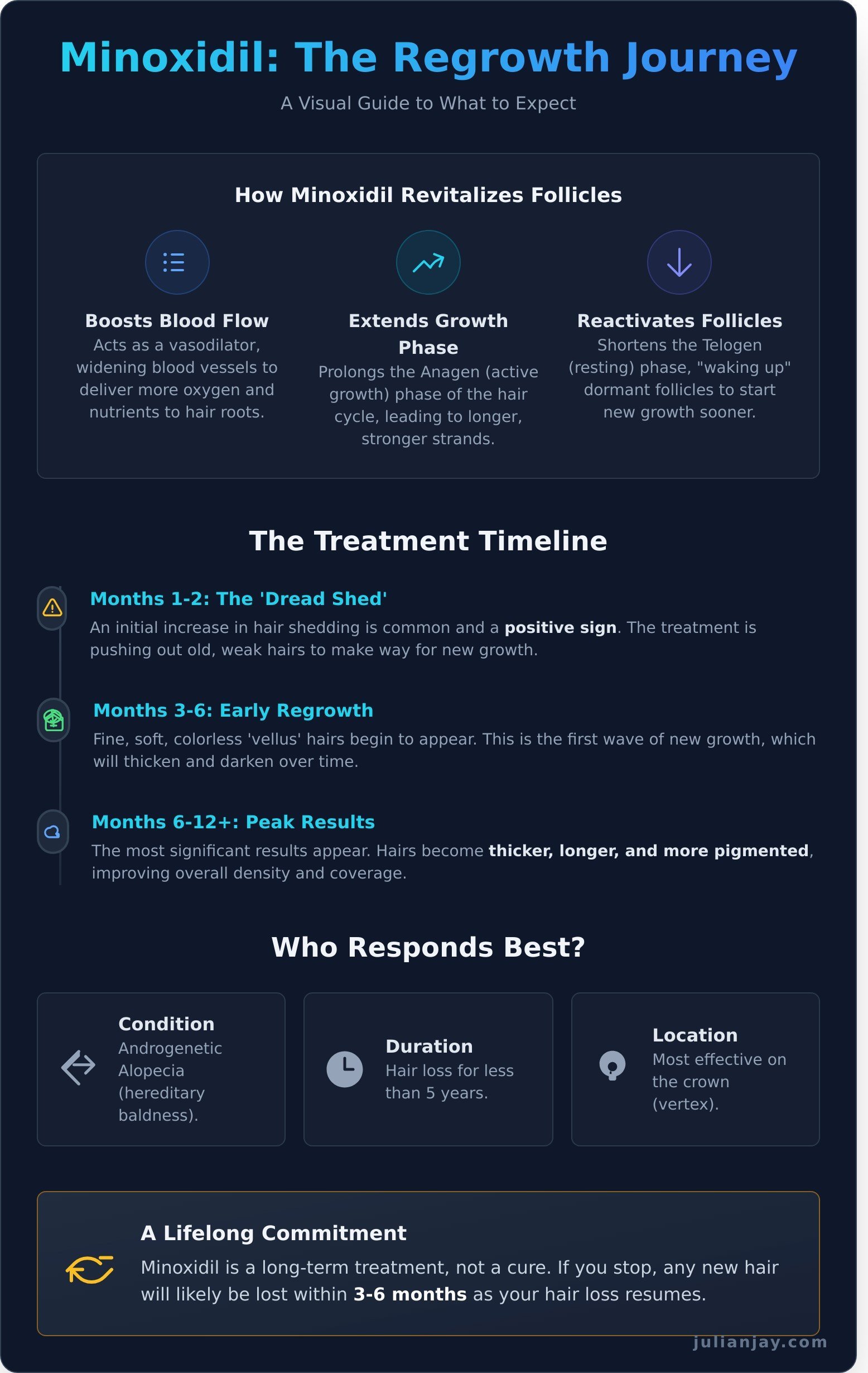
At its core, minoxidil is a vasodilator, meaning it works by widening the blood vessels. When applied to the scalp, it improves blood flow to the hair follicles. This enhanced circulation is crucial, as it delivers a richer supply of oxygen and essential nutrients directly to the hair root. This process helps to revitalise shrunken, underperforming follicles and prolongs the anagen, or active growth, phase of the hair cycle. The result is a healthier scalp environment conducive to growing stronger, thicker hair strands.
Understanding Hair Growth Phases and Minoxidil's Impact
To appreciate how minoxidil works, it’s helpful to understand the natural hair growth cycle, which consists of three key phases:
- Anagen: The active growth phase, lasting several years.
- Catagen: A short, transitional phase where the follicle shrinks.
- Telogen: The resting phase, lasting a few months before the hair sheds.
Minoxidil primarily works by shortening the telogen (resting) phase, effectively waking up dormant follicles and pushing them back into the anagen (growth) phase sooner than they would naturally. This is why some users experience an initial period of shedding. This process, while initially concerning, is a positive sign that the treatment is resetting your hair cycle, clearing out old, resting hairs to make way for new, healthy growth.
Efficacy and Results: What to Realistically Expect from Minoxidil
The primary question for anyone considering this treatment is straightforward: does it actually work? The answer, backed by extensive clinical research, is a qualified yes. Minoxidil is one of the most proven over-the-counter treatments for hair loss, but its effectiveness is not universal. Studies show that a significant portion of users-typically between 40% and 60%-experience some level of hair regrowth. However, managing expectations is crucial for a positive outcome. Success requires patience, consistency, and an understanding of the treatment process.
The Minoxidil Treatment Timeline
Regrowing hair is a slow, methodical process. Understanding the typical stages can help you stay committed and recognise the signs of progress along the way.
- Months 1-2: The Initial Shedding Phase. It may seem counterintuitive, but an initial increase in hair shedding is often the first sign that the treatment is working. This 'dread shed' occurs as dormant hair follicles are stimulated, pushing out old, weaker hairs to make way for new, healthier strands to grow.
- Months 3-6: Early Signs of Regrowth. After the shedding phase subsides, you may begin to notice fine, soft, and colourless hairs (vellus hairs) appearing in thinning areas. This is the first wave of new growth, which will gradually thicken and darken over time.
- Months 6-12: Peak Results. For most users, the most significant and noticeable results appear within this timeframe. Hairs become thicker, longer, and more pigmented, leading to improved density and scalp coverage.
Who Responds Best to Treatment?
While many can benefit, certain factors indicate a higher likelihood of success. Minoxidil is most effective for individuals who:
- Suffer from androgenetic alopecia (hereditary male or female pattern baldness).
- Are younger and have been experiencing hair loss for less than five years.
- Have hair loss concentrated at the vertex (crown) of the scalp, as it is generally less effective on a receding frontal hairline.
The Commitment: What Happens if You Stop Using Minoxidil?
It is vital to understand that minoxidil is a long-term treatment, not a cure for baldness. It works by stimulating and maintaining hair follicles in their growth phase. This commitment to consistent application is why understanding how to use minoxidil correctly is fundamental to achieving your goals. If you stop the treatment, the stimulated follicles will revert to their previous state. Any new hair that has grown as a result of the treatment will likely be shed within three to six months, and your hair loss will resume its natural course.
Potential Side Effects and Important Safety Considerations
While the Clinical Efficacy of Minoxidil is well-documented for many individuals experiencing hair loss, it is essential to approach its use with a clear understanding of the potential side effects. For most users, the treatment is well-tolerated, particularly when dosage instructions are followed precisely. However, being aware of the safety profile is a crucial part of any effective hair restoration journey.
Common Topical Side Effects
The most frequently reported side effects are localised to the area of application. These are generally mild and may subside as your scalp adjusts to the treatment. They include:
- Scalp Irritation: This can manifest as dryness, itching, redness, or flaking. It is often caused by propylene glycol, an ingredient used in many liquid minoxidil formulations to help the active ingredient penetrate the skin.
- Unwanted Hair Growth (Hypertrichosis): In some cases, particularly with women, the solution can drip or transfer onto the face, leading to fine hair growth on the forehead or temples. Careful application can help minimise this risk.
Less Common Systemic Side Effects
Though rare, minoxidil can be absorbed into the bloodstream and cause systemic effects. This is more likely if the recommended dose is exceeded or if it is applied to an irritated or broken scalp. It is vital to stop treatment and consult your GP immediately if you experience any of the following:
- Dizziness or lightheadedness
- A rapid or irregular heartbeat (tachycardia)
- Swelling in the hands, feet, or face (fluid retention)
- Chest pain or tightness
Before starting treatment, it is advisable to speak with a healthcare professional, especially if you are pregnant, breastfeeding, or have a pre-existing heart condition.
Considering a Gentler Approach
For many, the potential for chemical irritation or systemic side effects is a significant concern. If you prefer a treatment that works in harmony with your body's natural processes, trichologist-formulated, organic alternatives offer a compelling path forward. These formulations focus on nourishing the scalp and fortifying hair follicles with natural ingredients, providing a foundation for healthy growth without harsh pharmaceuticals. Discover a natural approach to hair and scalp health.
How to Use Minoxidil Correctly: A Step-by-Step Guide
To achieve the best possible results from your hair restoration journey, correct and consistent application is paramount. The efficacy of any treatment is directly linked to how it is used. Following a precise, methodical application routine ensures that the active ingredients can effectively stimulate the hair follicles and helps to minimise the potential for side effects. This guide provides the clinical standard for applying minoxidil to maximise its benefits.
Choosing Your Formula: Foam vs. Liquid Solution
The two primary formulations of this treatment offer distinct advantages. The foam version is often preferred as it dries quickly, is less greasy, and is generally better for those with sensitive skin as it does not contain propylene glycol, a common irritant. The traditional liquid solution, however, may offer slightly better absorption for some individuals and is often a more cost-effective option. Your choice depends on your lifestyle, hair type, and scalp sensitivity.
Step-by-Step Application Process
For optimal absorption and efficacy, follow this simple, clinically-advised process twice a day, typically once in the morning and once in the evening.
- Step 1: Start with a Dry Scalp. Ensure your hair and scalp are completely dry before application. Applying to a wet scalp can dilute the product and reduce its effectiveness.
- Step 2: Expose the Treatment Area. Part your hair in several rows within the area of thinning to ensure the product makes direct contact with the scalp, not just the hair.
- Step 3: Apply the Recommended Dose. Use the amount specified by the manufacturer-typically 1ml of the liquid solution (measured with the supplied dropper) or half a capful of the foam.
- Step 4: Massage and Absorb. Gently massage the solution into the affected areas of the scalp with your fingertips. Allow it to air dry completely.
- Step 5: Wash Your Hands. Thoroughly wash your hands with soap and water after application to prevent transferring the solution to other areas of the body.
Common Mistakes to Avoid
Avoiding these common errors is crucial for success and safety. Over-application will not accelerate hair growth but significantly increases the risk of side effects. Consistency is the most critical factor; skipping applications will interrupt the stimulation of the hair follicles and delay results. Finally, patience is essential. It can take 4-6 months of continuous use to see visible improvements, so stopping treatment prematurely is a primary reason for failure. By following these clinical guidelines, you create the optimal environment for revitalising your hair.
Minoxidil vs. Alternatives: Finding the Right Path for You
Choosing a hair loss treatment is a significant decision. While minoxidil is a well-known and effective option for many, it's crucial to understand how it compares to other treatments to determine the best approach for your specific needs. The path to healthier hair is not one-size-fits-all; it involves understanding the root cause of your hair loss and the mechanism of each potential solution.
Minoxidil vs. Finasteride: Growth Stimulant vs. DHT Blocker
One of the most common medical alternatives is Finasteride. Unlike minoxidil, which works as a vasodilator to stimulate hair follicles, Finasteride is a DHT blocker. It works systemically to reduce levels of Dihydrotestosterone (DHT), the hormone primarily responsible for shrinking follicles in male pattern baldness. In the UK, Finasteride is a prescription-only oral medication for men. These two treatments address hair loss from different angles and are sometimes prescribed together by a doctor for a combined effect.
The Limitations of a Single-Molecule Approach
Hair loss is often a multifactorial condition influenced by genetics, scalp health, inflammation, and nutrient deficiencies. A single-molecule treatment, while effective at its specific job, may not address the complete scalp environment. Simply stimulating growth doesn't resolve underlying issues like clogged follicles, poor circulation, or scalp inflammation, which can all hinder healthy, long-term hair production. For truly sustainable results, a more holistic philosophy is often required.
Exploring Natural, Trichologist-Formulated Alternatives
A comprehensive approach focuses on creating the optimal environment for hair to grow. Trichologist-developed botanical treatments are designed to do just that by nourishing the scalp and follicles directly. Using a system that includes a specialised cleanser, shampoo, and lotion can help to:
- Gently remove build-up from follicles.
- Reduce scalp inflammation with natural, organic ingredients.
- Improve blood circulation to nourish the hair root.
- Fortify and revitalise existing hair strands.
With a heritage of over 50 years in creating gentle yet effective formulations, these systems offer a time-tested, holistic path to restoring hair health without harsh chemicals. If you are seeking a solution that treats both the symptom and the cause, it may be time to explore a complete scalp care system. Learn about our Complete Hair Growth Treatment Kit.
Your Path Forward: Making an Informed Choice
Navigating the world of hair loss treatments can feel complex, but understanding your options is the first step toward taking control. We've seen that minoxidil is a clinically proven tool for stimulating regrowth, but its effectiveness must be weighed against the commitment it requires and the potential for side effects. Ultimately, the best treatment is one that aligns with your personal health goals and lifestyle.
If you are looking for a solution grounded in decades of trichological expertise, there is a gentle yet powerful alternative. Developed by a pioneering trichologist with over 50 years of experience, our formulations use effective organic ingredients to nourish the scalp and revitalise hair follicles at their source. We believe in results without compromise.
Concerned about side effects? Explore our gentle, trichologist-developed hair growth system. Your journey is supported by our 180-day money-back guarantee, giving you complete peace of mind to start your path toward healthier, fuller hair today.
Frequently Asked Questions About Minoxidil
Do you have to use minoxidil forever to maintain results?
Yes, continuous use is necessary to maintain the results achieved with minoxidil. It is a treatment, not a permanent cure for androgenetic alopecia. The medication works by stimulating dormant hair follicles. If you stop the treatment, the follicles will revert to their previous state, and any hair that has regrown as a result of the treatment is likely to shed within three to six months. Commitment to the routine is key for sustained benefits.
Can minoxidil regrow hair on a receding hairline or a bald spot?
Minoxidil is clinically proven to be most effective on the crown (or vertex) area of the scalp where hair follicles are often dormant rather than completely inactive. While some users may experience modest regrowth or a slowing of loss on a receding hairline, results in this area are typically less dramatic than on the crown. Efficacy is highest when treatment is started at the first signs of thinning, preserving the viability of the hair follicles.
What is the 'minoxidil dread shed' and how long does it last?
The 'dread shed' is an initial, temporary shedding phase that can occur when you start using minoxidil. This is a positive sign that the treatment is working, as it pushes out older, weaker hairs in the telogen (resting) phase to make way for new, stronger anagen (growing) hairs. This shedding period typically begins 2-8 weeks after starting treatment and usually subsides within a few weeks as the new growth cycle begins.
Can women use 5% minoxidil, or should they only use the 2% formula?
While the 2% formulation has traditionally been the standard recommendation for women in the UK, some 5% foam products are now licensed for once-daily female use. However, the higher concentration may increase the risk of side effects like scalp irritation or unwanted facial hair growth. It is essential to consult a trichologist or GP to determine the most appropriate and effective formulation for your specific condition and to ensure safe application.
Does minoxidil work for all types of hair loss, like alopecia areata?
No, minoxidil is specifically indicated for androgenetic alopecia (male and female pattern baldness). It is not the primary treatment for other conditions such as alopecia areata, which is an autoimmune disorder, or telogen effluvium, which is typically caused by stress or illness. A correct diagnosis from a qualified professional is crucial to ensure you are using the most effective treatment for your specific type of hair loss and to avoid ineffective therapy.
Are there effective, clinically-backed natural alternatives to minoxidil?
While certain natural ingredients like saw palmetto, caffeine, and rosemary oil have shown promise in some studies for supporting hair health, they do not possess the same level of extensive clinical evidence and regulatory approval as minoxidil for treating androgenetic alopecia. These natural compounds can be excellent supportive elements in a holistic hair care regimen but are not generally considered direct, clinically-equivalent replacements for stimulating significant hair regrowth on their own.
Will using more minoxidil make my hair grow back faster?
No, applying more than the recommended dose or using it more frequently will not enhance or accelerate your results. The effectiveness of the formulation is based on consistent, correct application as directed. Over-application will not lead to faster growth but will significantly increase the likelihood of absorbing excess medication, which can lead to unwanted side effects such as scalp irritation, dizziness, or unwanted body hair growth. Adherence to the instructions is vital for safety and efficacy.