


What if your thinning hair isn't an inevitable part of aging, but a signal that your follicles simply need a scientific wake up call? For the 50% of women who experience noticeable hair loss in women by age 50, the emotional distress of seeing more scalp than hair is a heavy daily burden. You've likely felt caught between the clinical world and natural remedies, unsure which path leads to real results. We understand that frustration. This guide unlocks the proven science behind minoxidil for women and shows you how to balance clinical treatments with holistic scalp care for lasting hair vibrancy.
We're bridging the gap between rigorous medical data and the nourishing care your scalp craves. You'll discover how to create a sustainable routine that delivers thicker, fuller hair while restoring the confidence you thought was gone. Drawing on over 50 years of trichological expertise, we'll preview the exact steps to revitalise your strands from the root up. It's time to stop worrying and start growing; after all, you've nothing to lose, especially not your hair.
Key Takeaways
- Understand the science of how minoxidil for women acts as a vasodilator to extend the anagen growth phase for thicker, fuller results by strengthening hair follicles.
- Learn why hair regrowth is a marathon rather than a sprint and what to realistically expect during the first eight weeks of treatment.
- Discover the truth about drug dependency and the long-term commitment required to maintain the vibrancy of hair gained through clinical treatments.
- Compare the "stimulation-only" approach of clinical drugs like finasteride and minoxidil with nutrient-dense, organic elixirs designed to deeply nourish the scalp and hair follicles.
- Explore a holistic "Activation & Stimulation" strategy to bring your hair back to life using expert trichological principles and high-potency formulations that reduce hair thinning.
What is Minoxidil for Women and How Does It Work?
If you've noticed your parting widening or more strands in your hairbrush, you aren't alone. Hair loss in women and thinning can be a distressing experience, but understanding the science behind hair regrowth offers a path toward confidence. Minoxidil was first introduced in the 1970s as an oral medication for high blood pressure. Physicians quickly noticed a surprising side effect: patients were growing hair in unexpected places. By 1988, the FDA approved it as a topical solution, and it has since become the gold standard for minoxidil for women seeking to reclaim their hair's natural volume.
It's vital to understand that Minoxidil is a potent vasodilator. Its primary role is to extend the anagen, or growth, phase of your hair cycle. While temporary thinning like telogen effluvium often resolves on its own after a stressful event, Androgenetic Alopecia (a hereditary hair loss condition similar to male pattern baldness) is a progressive genetic condition. Minoxidil doesn't "cure" hair loss in a permanent sense. Instead, it manages the symptoms by keeping hair follicles active. You've nothing to lose, especially not your hair, but consistency is key; the benefits continue only as long as you maintain the treatment.
The Mechanism of Action: From Scalp to Follicle
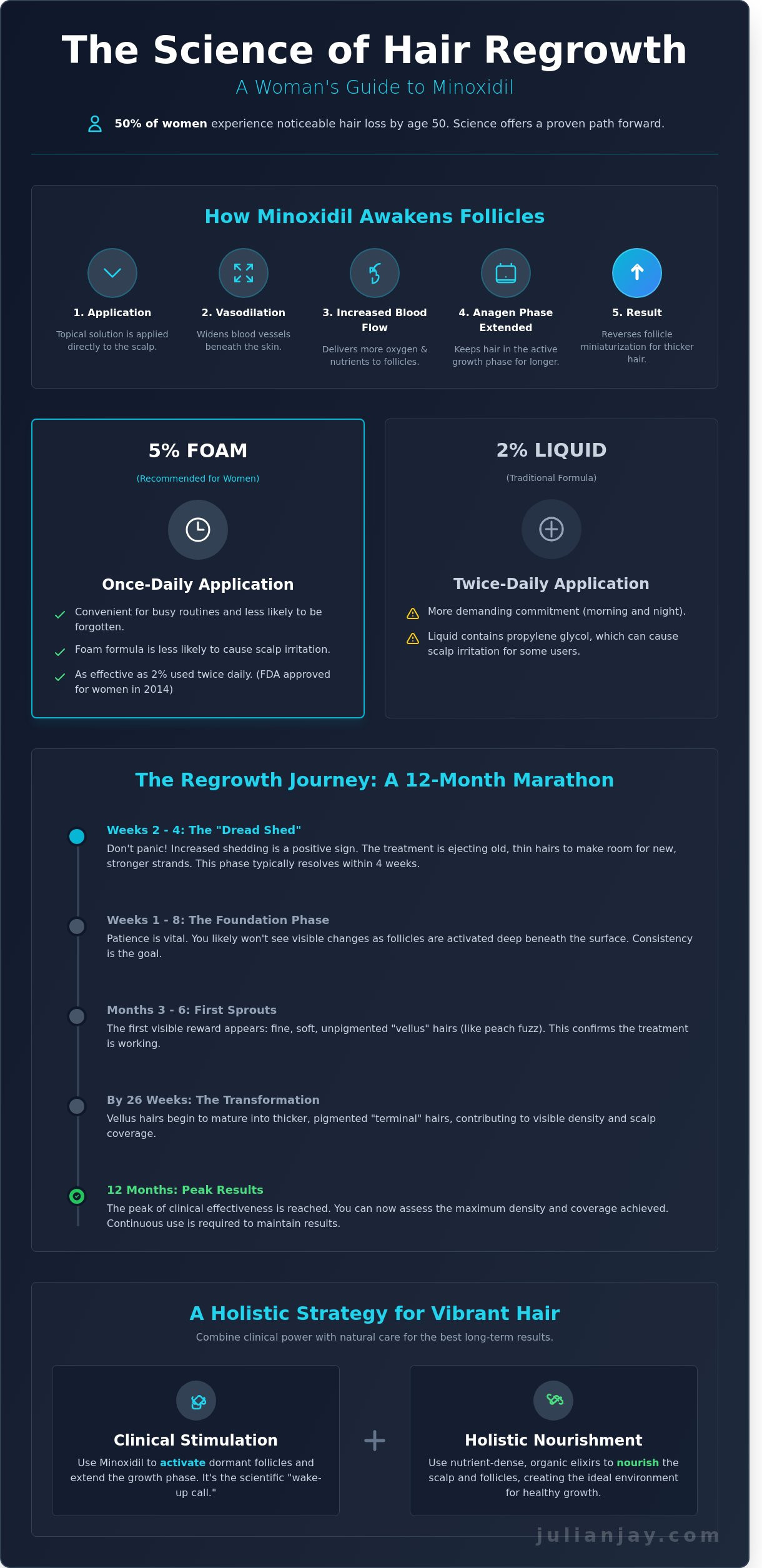
The magic happens beneath the surface of your skin. When applied, the solution widens the blood vessels in the scalp. This increased blood flow acts as a delivery system, bringing vital oxygen and nutrients directly to the root of each strand. Over a period of 12 to 16 weeks, this process reverses follicle miniaturization, which is the shrinking of hair follicles leading to wispy, fragile hair. By increasing the diameter of the hair shaft, the treatment creates a denser, more vibrant appearance across the scalp. Minoxidil is a topical hair loss treatment that revitalizes dormant hair follicles.
2% vs. 5% Concentrations: Which Should Women Use?
Choosing the right formulation depends on your lifestyle and scalp sensitivity. Traditionally, women were prescribed a 2% liquid solution to be applied twice daily. In 2014, the FDA approved a 5% aerosol foam for once-daily use by women, a concentration previously reserved for men. Many women now favour the 5% foam because it's less likely to cause the scalp irritation often associated with the propylene glycol found in liquid versions. When selecting a product, always look for specific "for women" labelling. These formulations are designed to provide the high-potency results you need while respecting the delicate balance of the female scalp environment. Clinical studies show that 5% foam is just as effective when used once a day as the 2% liquid is when used twice, making it a convenient choice for a busy routine.
What to Expect: The Timeline of Hair Regrowth
Patience is the most vital ingredient in any hair restoration journey. Think of minoxidil for women as a marathon rather than a sprint; your hair follicles require time to shift from a dormant state into an active growth phase. The biological reality of hair growth means you are working with cycles that take months to shift, not days. Clinical data indicates that most users won't see any visible changes during the first 8 weeks of treatment. This initial period is often the most difficult, as you are putting in the effort without immediate visual reward.
Between months 3 and 6, you will likely notice the emergence of vellus hair. This "peach fuzz" is fine, soft, and often lacks pigment. It is a sign that the follicles are revitalising. By the 26-week mark, these fine hairs typically begin to transition into terminal hairs, which are thicker and more pigmented. Achieving the peak of clinical effectiveness usually takes a full 12 months of daily application. At this one-year milestone, you can accurately assess the maximum density and coverage the treatment can provide for your specific hair type.
The "Dread Shed": Why Losing Hair is a Sign of Progress
It sounds counterintuitive, but losing hair in the first 2 to 4 weeks is a positive clinical indicator. This phenomenon, known as the "dread shed," occurs because minoxidil accelerates the transition of hair follicles from the telogen (resting) phase to the anagen (growth) phase. To make room for new, stronger strands, the follicle must first eject the old, thinning hair. It's a sign the medication is successfully resetting your hair cycle.
- Don't panic: Increased shedding usually resolves within 4 weeks.
- Be gentle: Use a wide-tooth comb and avoid tight hairstyles that pull on the scalp.
- Stay focused: Remind yourself that every hair lost is being replaced by a healthier version.
Managing the emotional stress of this phase is easier when you view it as a necessary clearing of the path. If you find the shedding period particularly distressing, consider using a gentle, trichologist-approved shampoo to support the scalp environment while the new growth takes hold.
Consistent Application: The Key to Success
Consistency determines your final results. If you choose the liquid formulation, use the provided dropper to apply the solution directly to the thinning areas of a dry scalp. If you prefer the foam, half a capful is the standard dose. Massage the product in with your fingertips to ensure it reaches the skin rather than just sitting on the hair strands. Applying the product to a damp scalp can increase absorption too much, which might lead to irritation, so always wait until your hair is completely dry.
Missing doses can reset the progress of the hair cycle. When you stop application, the blood flow to the follicles decreases, and they may return to their previous thinning pattern within a few months. Integrate the treatment into your morning or evening beauty routine, just like brushing your teeth. This habit ensures your hair follicles receive the constant stimulation they need to stay in the growth phase indefinitely.
The Reality of Side Effects and Drug Dependency
If you decide to start your journey with minoxidil for women, you're likely asking the most common question: what happens if I stop? It's a valid concern that every woman should weigh before beginning. Minoxidil isn't a permanent cure for hair loss; it acts as a temporary stimulant. Clinical data shows that any hair regrowth achieved typically begins to shed within 12 to 16 weeks after you discontinue treatment. This dependency occurs because the drug artificially extends the growth phase of your hair follicles. Once that external stimulus disappears, the follicles return to their previous cycle, often leading to a rapid loss of the very hair you worked so hard to regain.
Using synthetic chemicals daily can disrupt your scalp's delicate microbiome. This ecosystem of bacteria and natural oils protects your skin from inflammation and infection. Long-term reliance on chemical-heavy solutions can leave the scalp feeling sensitised or reactive. Many women feel uneasy about applying industrial-grade chemicals to their skin for decades. As experts in hair health since 1967, we understand that true confidence comes from a solution that feels safe and sustainable for your body.
Common Side Effects in Women
The most frequent complaint involves scalp irritation. Roughly 7% of users experience contact dermatitis, often caused by propylene glycol. This ingredient helps the formula penetrate the skin but can leave the scalp red, flaky, and itchy. Another concern is hypertrichosis, or unwanted facial hair growth. This affects approximately 5% of women using the 5% concentration. You can minimise this risk by washing your hands thoroughly after application and ensuring the product doesn't transfer to your pillowcase at night. Consult a doctor or a qualified trichologist immediately if you experience rapid weight gain, swelling in your hands, or chest pains.
The Scalp Health Trade-off
Many liquid formulations rely heavily on alcohol to keep the active ingredients in solution. This high alcohol content strips away natural oils, creating a "desert" environment on your head. You might notice your scalp becoming dry or brittle over time. A healthy scalp is the foundation for any successful treatment. You simply cannot grow vibrant hair in an environment that's constantly inflamed or dehydrated. Balancing follicular stimulation with deep nourishment is essential. Without addressing the underlying health of the scalp tissue, you're only treating a symptom rather than supporting the long-term vitality of your hair. You've nothing to lose by seeking a more holistic approach to your scalp's health.
Clinical Drugs vs. Organic Trichological Solutions
Choosing between clinical drugs and organic solutions is a pivotal step in your hair regrowth journey. While minoxidil for women is a widely recognised pharmaceutical option, it primarily functions as a vasodilator. It focuses on a single mechanism: stimulating blood flow to the hair follicle. Organic trichological solutions take a different route by prioritising high-potency, nutrient-dense formulations. These products don't just stimulate; they nourish the entire scalp environment to create sustainable growth conditions. Instead of relying on a "stimulation only" approach, organic paths focus on the long-term health of the hair fibre strands and reducing hair loss.
The Power of Organic Ingredients
Julian Jay's formulations have been carefully crafted by a pioneering trichologist since 1967. Unlike synthetic stimulants that can be harsh, these organic elixirs use natural blood-flow stimulants to revitalise dormant hair follicles. Many women experience scalp dryness or irritation with chemical treatments. Opting for vegan and paraben-free ingredients removes these synthetic irritants from the equation. This is a significant advantage for the estimated 40% of women who deal with scalp sensitivity. By keeping hair follicles clear of chemical buildup, you ensure that new hair strands can emerge vibrant and strong. These formulations work in harmony with your body rather than forcing a chemical reaction.
Making the Choice: Which Path is Yours?
Your decision often rests on the severity of your hair thinning and your personal health philosophy. If you're looking for a gentle yet effective way to bring your hair back to life, the organic path offers a professional alternative. Our 50 years of expertise has led to the development of the Complete Hair Growth Treatment Kit, which follows a structured Activation and Stimulation Phase. This holistic approach treats hair loss treatment as a biological puzzle rather than just a surface-level problem. You can even use these organic elixirs alongside minoxidil for women to soothe the scalp and provide the nutrients that synthetic clinical drugs lack.
- Early Thinning: Organic elixirs provide the necessary nourishment to fortify hair fibre strands before loss becomes severe.
- Sensitive Scalps: Natural ingredients avoid the redness and itching often associated with synthetic drug applications.
- Long-term Maintenance: Organic solutions are safe for continuous use without the "rebound" hair loss sometimes seen when stopping clinical drugs.
We stand by our formulations with a 180-day money-back guarantee. This ensures you can start your hair loss treatment journey with total confidence. You've nothing to lose, especially not your hair! Our goal is to provide a hopeful, science-backed route to thicker, fuller hair that lasts a lifetime.
Ready to revitalise your hair follicles with a holistic approach? Browse our expert-approved Hair Growth Treatment Kits today.
A Holistic Strategy for Vibrant Hair and Scalp
While minoxidil for women offers a clinical pathway to hair regrowth, achieving a truly vibrant head of hair requires more than a single ingredient. At Julian Jay, we believe in a holistic philosophy: "Bring Your Hair Back To Life!" This isn't just a slogan; it's a methodology perfected over 50 years by our pioneering trichologists since 1967. We focus on an "Activation & Stimulation" phase that prepares the scalp environment to support new growth, ensuring every strand has the best possible chance to thrive.
A clean scalp is non-negotiable. Without removing the microscopic debris and calcified sebum that blocks the follicle, even the most advanced hair loss treatments can't reach their target. Our specialised cleansers are formulated to address this, creating a pristine environment where activation can actually begin. This process reduces inflammation and clears the way for nutrient-rich formulations to penetrate deeply.
The Julian Jay 3-Step Routine for Women
A healthy scalp is the foundation of hair recovery. Our 3-step routine is designed to work synergistically with your body's natural cycles:
- Step 1: Cleansing. We use specialised cleansers to unblock hair follicles and reduce scalp inflammation. Removing sebum buildup and environmental pollutants is critical for nutrient absorption.
- Step 2: Nourishing. Our Hi-Potency shampoo formulations deliver essential nutrients directly to the root. This stage focuses on reducing shedding and fortifying the hair fibre strands from the inside out.
- Step 3: Stimulating. Finally, our lotion spray uses raw elixirs to improve blood circulation. This creates thicker, fuller strands by extending the growth phase of the hair cycle.
Long-term Maintenance and Confidence
Many women worry about being tethered to a pharmaceutical drug forever. Our approach provides a sustainable alternative or supplement to minoxidil for women, focusing on botanical integrity and long-term scalp health. We want you to feel confident in your choice. That's why we offer a 180-day money-back guarantee. It reflects our absolute belief in these formulations, which have been refined for over five decades.
You've nothing to lose, especially not your hair! Your journey toward recovery is deeply personal, but it doesn't have to be overwhelming. By shifting from a "quick fix" mindset to a structured, trichologist-led routine, you manage hair loss treatment with professional precision. There's always hope for restoration when you treat your scalp with the care it deserves. We're here to guide you through every stage of the process.
Take Control of Your Hair Growth Journey Today
Deciding how to treat thinning hair is a personal choice that requires balancing clinical results with long-term health. While minoxidil for women offers a recognised path to hair regrowth, it often requires a lifetime commitment to avoid reversing any progress. You've seen how the timeline for results spans four to six months and why addressing the underlying scalp environment is just as vital as stimulating the hair follicles. It's about more than just a quick fix; it's about lasting vitality.
If you're looking for a way to revitalise your hair without the worry of harsh side effects, consider a path backed by over 50 years of trichological expertise. Since 1967, Julian Jay has crafted clinically-inspired organic formulations that nourish the scalp and fortify every strand. These hi-potency elixirs provide a sophisticated alternative for those who prefer natural, vegan ingredients over synthetic dependencies. We believe so strongly in these results that we offer a 180-day money-back guarantee. Discover the Julian Jay Organic Alternative to Hair Growth. You've nothing to lose, especially not your hair!
Frequently Asked Questions
Can I use Minoxidil if I have a sensitive scalp?
Yes, you can use minoxidil for women with a sensitive scalp, but you should choose the 5% foam version instead of the liquid. Clinical data indicates that liquid formulas contain propylene glycol, which triggers contact dermatitis in roughly 7% of users. The foam is alcohol-free and significantly gentler on the skin. Always perform a patch test on a small area for 24 hours before starting your full treatment to ensure your scalp remains comfortable.
Will Minoxidil for women cause facial hair growth?
Unwanted facial hair growth occurs in approximately 4% of women during clinical trials, usually due to accidental product transfer. This happens when the solution rubs onto your pillow and then your face, or if you touch your forehead after application. To prevent this, apply the treatment at least 2 hours before bed and wash your hands with soap immediately. If fine hairs do appear, they typically vanish within 4 months of stopping use.
How long do I have to use Minoxidil to see results?
You’ll typically see the first signs of new hair regrowth after 12 to 16 weeks of consistent daily application. Hair follicles move through slow biological cycles, so patience is essential during the initial stimulation phase. While some see fine "peach fuzz" by month 4, the most significant density improvements usually appear after 12 months of use. Consistency is vital to move your hair from the resting phase into the active growth phase.
What happens if I stop using Minoxidil for a few days?
Missing your application of minoxidil for women for 2 or 3 days won't cause immediate shedding or ruin your progress. However, if you stop the treatment for more than 90 days, your follicles will return to their previous state. Any hair regrown during the treatment will likely shed within 3 to 4 months of total cessation. Consistency is the secret to maintaining the revitalised, fuller look you've worked hard to achieve over the months.
Can I color my hair while using Minoxidil?
You can safely color or chemically treat your hair while using this hair loss treatment. To avoid scalp irritation, don't apply the solution for 24 hours before and 24 hours after your salon appointment. This short window allows your scalp's natural oils to recover and prevents the chemicals from reacting with the formula. Ensure your stylist thoroughly washes out all hair dye or bleach before you resume your nightly application routine at home.
Is there a natural alternative to Minoxidil that actually works?
Rosemary oil is a scientifically backed natural alternative, with a 2015 study in the journal Skinmed showing it performed similarly to 2% minoxidil after 6 months. For those seeking a professional solution, our trichologist-developed Pro-Enzyme formulations provide a potent, scalp-friendly option. These elixirs have been refined since 1967 to nourish hair follicles and support hair health using gentle, organic ingredients. You've nothing to lose, especially not your hair, by choosing expert-led botanical care.
Is Minoxidil safe for women during pregnancy or breastfeeding?
No, medical experts advise against using this treatment during pregnancy or while breastfeeding. The FDA classifies it as a Category C medication, meaning its effects on a developing foetus haven't been fully determined in human studies. If you're planning to conceive or are currently nursing, consult your GP or a registered trichologist. They can recommend safer, nutrition-based ways to manage postpartum shedding until it's safe to resume stronger, hi-potency formulations for hair regrowth.